Run the scenarios you'd normally skip
Once the geologist hands over the block model, the schedule is yours, and every extra scenario costs days. Cognomine takes the model and the constraints your study turns on, and returns a practical plan in minutes. You spend the time on the decisions that matter for the site instead of the mechanics of a feasible schedule.
Now in use at an ASX-listed mining company.
Where the time goes
Optimiser output needs rebuilding.
To solve a long horizon in reasonable time, the constraint set is normally trimmed back, so the plan that comes back isn't one a crew could run. Many planners skip optimisation altogether because the output would need a full rework.
Three steps, three tools.
Pit selection, scheduling and haulage are usually separate passes. Keeping them aligned every time an assumption moves eats a good share of the study.
Two or three cases reach the decision.
When each pass is its own piece of work, the study commits early and finds out later whether the direction was right.
What changes
Three solves in one pass, with the operating constraints held inside it.
Solved together, with real-world constraints
Constraints stay in the solve.
- Bench and phase sequencing, dig precedence
- Drill-and-blast lag, digger separation
- Slopes set per pit or block by block
- Haulage and processing capacity
- Grade targets and stockpile strategy
Plans come back closer to what can be mined, so review time goes into judgement.
It recommends, not only sequences.
Cognomine recommends the dig order and the fleet size. A scheduling tool sequences the fleet you give it.
Minutes per run.
Change a price deck, a cut-off or a slope and run it again. Re-run it before the plan is set, and again as site conditions change.
Phasing if you need it.
Bring your phases, or let Cognomine propose indicative ones and show where the value sits.
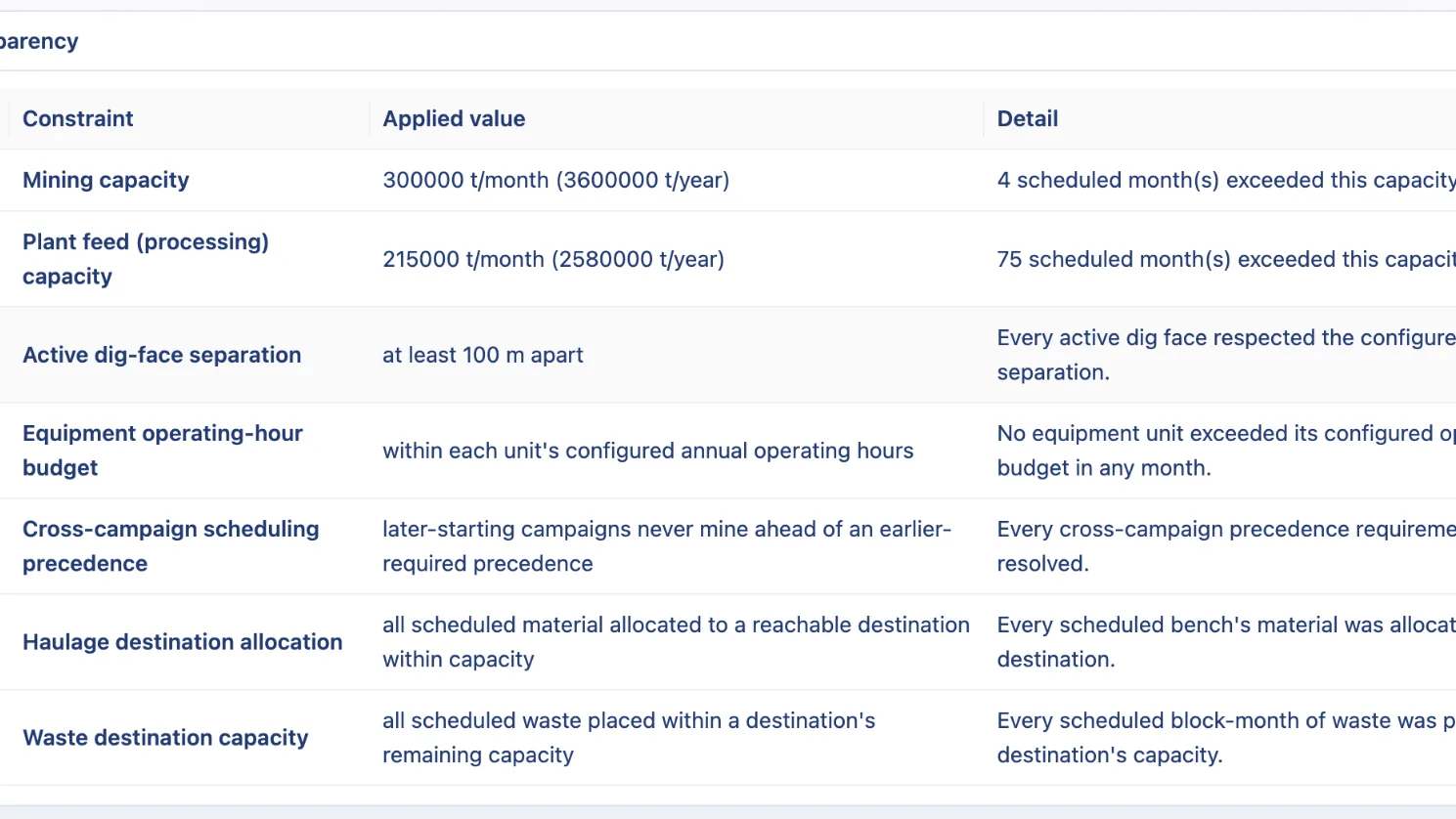
Constraint diagnostics.
Every run shows which limits are holding and where, so you can explain the plan you recommend.
Proof
Many planners we've spoken with told us they have never seen another tool handle this many constraints and still return a plan this quickly.
On a ten-year strategic plan, Cognomine returned a plan in minutes. Google OR-Tools, on the same orebody and constraint set, was stopped unconverged at 12 hours.
Hosted on Microsoft Azure in Australia. Your data is logically isolated to your account and removed within 30 days after your entitlement ends.
What it costs
Run as many scenarios as the study needs.
One credit buys unlimited runs on one block model file for 3 or 12 months. There is no run quota and no compute bill, so the twentieth scenario costs the same as the first. A revised block model is a new credit. At the beta price, a credit is A$11,700 for 3 months, plus GST.
Approval tied to outcome.
You ask for one study's plan, not a software licence. The price is per study and published, so you can budget before you talk to us. We invoice against a quotation.
Nothing to lose by trying.
A first plan on us is free, and your organisation's first purchase has a 7-day money-back guarantee.
Where it fits
Fit
- Strategic, life-of-mine and medium-term planning
- Open-pit metals projects, from scoping to feasibility and the re-plans behind each reporting cycle
- Not detailed pit design, such as fitting ramps
- Not short-term production scheduling
Your files
- In: CSV from Vulcan, Surpac, Datamine, Deswik or Micromine, or OMF v2
- Out: the schedule to Spry and spreadsheets
Peer data
See what other studies assumed: the ASX open-pit study tracker lists the planning inputs from scoping, pre-feasibility and feasibility studies on Australian open-pit projects, released by ASX-listed companies since 1 January 2026.
How to start
- 1
Try the sample model
Run it yourself on our sample model: change an input, solve again, see the plan. No call, nothing to upload. Try the sample model
- 2
See the demo
A click-through of a solved synthetic model. Ask and we walk you through it on a call. See the demo
- 3
First plan on us
One free plan on your own block model, imported with Donny. 14 days, for evaluation. First plan on us
- 4
Buy a credit
Unlimited runs on one model for 3 or 12 months. See pricing
Common questions
What block model formats does Cognomine accept?
CSV exported from Vulcan, Surpac, Datamine, Deswik or Micromine, or OMF v2. The import wizard maps your columns, so there is no template to match.
How long does a run take?
A standard run takes under ten minutes. High Fidelity, which keeps the model closer to its original resolution, takes around an hour.
Which constraints stay in the solve?
Bench and phase sequencing, dig precedence, drill-and-blast lag, digger separation, slopes per pit or block by block, haulage and processing capacity, grade targets and stockpile strategy.
How large a block model can it take?
Raw block models up to around one million blocks. Every model is reblocked before solving: under 100,000 scheduling units in a standard run, up to 500,000 in High Fidelity.
What doesn't it do?
Detailed pit design, such as fitting ramps, and short-term production scheduling. It is built for strategic, life-of-mine and medium-term planning on open-pit metals projects.
How much does it cost?
One credit buys unlimited runs on one block model for 3 or 12 months. At the beta price a 3-month credit is A$11,700, plus GST.
See it on your scenario
- Thirty minutes or less. No deck.
- You speak to Donny, our CTO, and Ray, our CEO.
- Share an overview of a study you are working on, or one you are tackling soon. We help assess whether Cognomine is a fit.
- If Cognomine is wrong for the work you do, we will tell you on the call.